To a principal managing serious capital,
If you already invest through large managers, you know the ritual. The glossy fund deck. The hockey-stick projection. The fee schedule that begins at two-and-twenty. And the one sentence that ends most meetings: “the underwriting is proprietary.”
So let me ask the question a careful principal should ask before issuing a mandate: when you write that cheque, what exactly are you buying?
Because here is what happens when nobody asks it. You get exposure to a market — but not control of an asset. You get a projected return — but not the assumptions underneath it, or the stress case behind it. You get a manager’s confidence — and you keep the risk. In a pooled structure that trade is priced in fees you pay every year, whether the thesis works or not.
We built Murivest differently, and Investor Suite is the digital expression of that approach. Murivest Group Ltd is an international commercial real estate services and investment firm — principal offices in Nairobi and London, Grade A income-producing assets, fiduciary standards, KYC/AML verified. We do not pool capital. We do not operate collective investment schemes. Every engagement is direct, non-pooled and mandate-only: your capital, your name on the deed, your underwriting — on your side of the table.
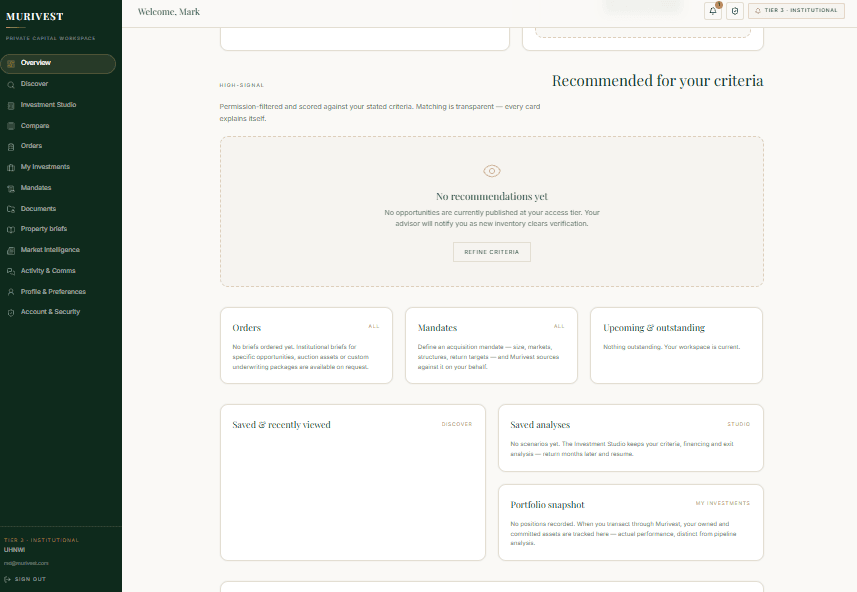
Investor Suite is designed to answer six questions we believe you should never have to ask twice: what exclusive or better-structured opportunities exist right now; can I see institutional underwriting and stress tests before I commit; can I model capital structure, leverage and exits myself; can I order a deep institutional brief — and pay for it — in minutes; is every interaction, document and decision tracked in one secure workspace; and will this stay private, high-signal and noise-free. You will find those six answers just below this letter.
I recorded a short video — my face, my voice, in our own offices — because in this business trust is earned in person, not in a headline. Watch it, download the manual, take your time. Then, if the standard matches yours — or the standard you want to hold — request access. Where you go from there is entirely your decision. That is rather the point.